Thursday, May 26, 2011

"Carte Blanche" Released Elsewhere Today


Carte Blanche, the new James Bond novel by Jeffery Deaver, was released today in the UK, Ireland, Australia, New Zealand, Italy, the Netherlands, and Korea. Unfortunately, those of us in the United States and Canada have to wait over two weeks until June 14th. It's so unfair.

To make the wait more bearable, Amazon UK has a description of the book:

"The face of war is changing. The other side doesn't play by the rules much any more. There's thinking, in some circles, that we need to play by a different set of rules too . . ."'

Fresh from Afghanistan, James Bond has been recruited to a new agency. Conceived in the post-9/11 world, it operates independent of Five, Six and the MoD, its very existence deniable. Its aim: to protect the Realm, by any means necessary.

The Night Action alert calls Bond from dinner with a beautiful woman. GCHQ has decrypted an electronic whisper about an attack scheduled for later in the week: casualties estimated in the thousands, British interests adversely affected.

And 007 has been given carte blanche to do whatever it takes to fulfil his mission.

Jeffery Deaver has also provided the first two chapters of the book at his web site:
Carte Blanche Exerpt

Found on eBay: Hughes Jet Pack Pogo Stick


Artist's impression of Hughes Jet Pack Pogo Stick found on eBay.

Source:
http://cgi.ebay.com/DRAWING-CONCEPT-ART-HUGHES-JET-PACK-POGO-STICK-/170601595578?pt=LH_DefaultDomain_0&hash=item27b8a5c2ba


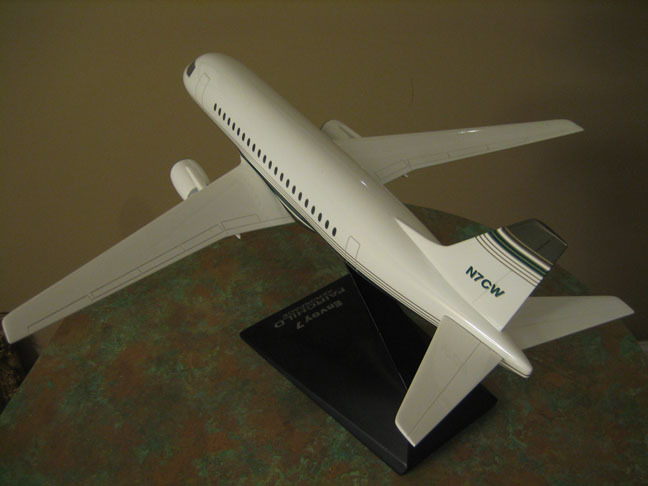
Found on eBay: Fairchild Dornier Envoy 7


Model of Fairchild Dornier Envoy 7 manufactured by Pacmin found on eBay. The Fairchild Dornier Envoy 7 was a corporate jet version of the Dornier Fairchild 728 regional jet airliner. A later version of the Fairchild Dornier Envoy 7 design featured "Super Shark" winglets.

Source:
http://cgi.ebay.com/Rare-Fairchild-Envoy-7-Jet-Passenger-RJ-Plane-1-50-NR_W0QQitemZ220564746172QQcmdZViewItemQQptZLH_DefaultDomain_0?hash=item335aaeefbc


Found on eBay: Lockheed SST concept (1959)


Artist's impression of Lockheed SST concept from 1959 found on eBay.

Attached press release:
6/17/59 LOS ANGELES: Artist's conception shown could be an airliner of 1965 and as such, according to Hall L Hibbard, Senior Vice President of Lockheed Aircraft, the vehicle could leave London at 11 AM, arrive in New York at 8:20 AM, and get to Los Angeles at 7:45 AM, all in the same morning. The plane might carry 90 passengers at altitudes of 60,000 to 90,000 feet an operate from existing airports.

Found on eBay: Lockheed GL 136 B-1


Model of Lockheed GL 136 B-1 tilt-wing assault transport found on eBay.

Seller's description:
We offer for auction a rare one off prototype model made by Lockheed from around the late 1950′s or early 1960′s. This model is made from painted wood, it has a 22″ wingspan & is approx. 16″ long. The propeller nose cones are aluminum & it has a wooden base with a slightly rusted steel support stem. There is a bronze plaque on the base that reads ” GL 136 B-1 Assault Transport Lockheed Aircraft Corp. Georgia Division Marietta Georgia” I think this was a proposal & never built, I cannot find any information about this aircraft. The model comes in it’s original wooden carrying case. The model when we found it was dirty, it also had some surface paint cracks were the tip tanks were mounted to the wings & some other areas. The markings which seemed to be hand painted were smudged in a couple of spots & a number of the prop blades were detached. We gave this model to a master model maker that made similar model for the airlines & the military. He cleaned it up & touched up the areas needing work. This was not a major job & it is almost impossible to see any restoration. This is a beautiful professional design model & one of a kind model. The wooden carrying case measures approx. 28″ x 20″ x 12″ & is quite heavy.
Source:
http://cgi.ebay.com/Airplane-Lockheed-Prototype-Concept-Desk-Display-odel_W0QQitemZ170365888797QQcmdZViewItemQQptZLH_DefaultDomain_0?hash=item27aa99291d&_trksid=p3286.c0.m14


Wednesday, May 25, 2011

U.S.S. Pegasus MSD


Master Systems Display (MSD) artwork by Rick Sternbach for U.S.S. Pegasus NCC-53847 created for the Star Trek: The Next Generation episode "The Pegasus" 1994.
According to Rick Sternbach, the producers originally intended to create a new starship design for the episode. In a post on TrekBBS, Sternbach writes:
As far as the Pegasus was concerned, yes, there were a few sketches of a ship done, but to make it easy on the VFX folks it was supposed to be a kitbash of sorts from either a Nebula or an Ambassador ( I don't have the sketches handy, so I can't recall exactly).
From this sketch, it's clear that the U.S.S. Pegasus was meant to be a kitbash of the Ambassador class. Instead of building a new model, the U.S.S. Grissom model from Star Trek III: The Search for Spock was re-painted and the U.S.S. Pegasus became an Oberth-class starship.

Source:
http://www.trekbbs.com/showpost.php?p=1295542&postcount=11

Sea-based Anti-Ballistic Missile Intercept System (SABMIS)


The Sea-based Anti-Ballistic Missile Intercept System (SABMIS) program, sometimes referred to as Seaborne Anti-Ballistic Missile Intercept System, was a US Navy program to develop a seaborne ICBM defense. Contracts to study the concept were awarded in 1967 to Hughes Aircraft Company, Lockheed Missiles and Spacecraft Company, and Newport News Shipbuilding and Drydock Company working in concert. The SABMIS program studied the use of submarines and surface ships as launch platforms for ABM missiles. With the ability to move these ships forward to positions around the periphery of the Soviet Union or People's Republic of China, it would be possible to detect the launch of enemy missiles and intercept them during the boost or mid-course phase of their flight trajectory.

One of the designs created by the SABMIS program was an anti-ballistic missile ship. From Jane's Fighting Ships 1969-70:


ANTI-BALLISTIC MISSILE SHIP. The Navy also is studying a Sea-based Anti-Ballistic Missile Intercept System (SABMIS). The SABMIS concept is offered by the Navy as a supplement and possibly alternate to the "thin" Safeguard/Nike-X Anti-Ballistic Missile (ABM) system proposed by the Nixon Administration. Although certain factions within the Navy and in the Congress have advocated a comparative analysis of the proposed SABMIS and Safeguard concepts, the official policy of the Departments of Defence and Navy has been to consider SABMIS only as a study for a backup or "in depth" complement to the Safeguard system. Reportedly, approximately $3,000,000 has been spent on SABMIS compared to approximately $4 billion on Safeguard Nike-X studies, research, and development. In view of the existing political situation with President Nixon's Administration firmly committed to a policy of deploying the Safeguard system, it appears unlikely that SABMIS could be developed so long as there is any interest in the Safeguard system. The proposed SABMIS ship is described on a subsequent page of the listings for Strategic Warfare Ships.

Displacement, tons 20000-30000 full load
Length, feet (metres) approx 700 (214.0)
Missiles approx 40-60 ABM
Several Point Defense Missile System (PDMS) launchers
Nuclear reactors 2 pressurised-water cooled
Main engines Geared turbines, 2 shafts

The US Navy has studied the feasibility of a Sea-based Anti-Ballistic Missile Intercept System (SABMIS) to provide an effective and relatively low cost defence against intercontinental ballistic missiles. The SABMIS - concept provides for tracking/missile ships which could be deployed to intercept enemy ICBMs early in their flight, before multiple warheads and penetration decoys break away from the launching rocket. Thus, a sea-based ABM would have one target per enemy ICBM whereas a land-based ABM system in the target area would have to cope with several re-entry packages for every enemy missile which is fired.

The radar to detect an enemy ICBM launching, the fire control computers, missile guidance, and the ABM missile launchers would all be mounted in a single ship under the SABMIS concept. It is anticipated that an extremely small number of ships could provide the capability of intercepting the approximately 40 intercontinental missiles which Communist China would be able to launch against the United States in the mid-1970s. Also, the SABMIS concept could provide a low-cost "thin" defence against an "accidental" Soviet ICBM launching of a small number of missiles against the United States. (Most authorities agree there is today no possiblity of providing defence against an all-out Soviet ICBM strike against the United States). However, even against a threat of this size a force of several SABMIS ships may be desired, to provide for survivability in the event of war and for normal overhaul and training. Still, a multi-ship SABMIS force, with nuclear powered-escort ships, is expected to cost considerably less than the $8 to 40 billion Safeguard, Nike-X "thin" ABM defence now being proposed for the United States.

A sea-based ABM would appear to offer several major advantages over a land-based system:


  • The problems of detecting and destroying an ICBM' during the launch-boost stage is far less complicated than seeking to locate and destroy several re-entry packages (warheads and decoys).


  • The Safeguard/Nike-X ABM is a "sector system" with each of the planned 12 missile sites defending a sector of the United States. Thus, each site must have the capability of intercepting all intercontinental missiles which China is expected to have available in the mid-1970s. However, a single SABMIS ship could be positioned to intercept virtually all missiles being fired at the United States because of the limited China-to-United States ICBM trajectory spectrum.


  • A sea-based system would not increase the number of strategic targets within the United States which would be attacked in a nuclear conflict.


  • The mobility of a sea-based ABM will enable the defence to be shifted as the threat changes. For example, an ABM system in the United States could not provide for defence against ICBMs aimed at Japan. A sea-based ABM could counter Chinese ICBMs being launched against virtually any Asian target.


  • Should the opposition develop an anti-ABM system (in the same manner that anti-radar missiles have been developed) the sea-based ABM ships probably would be less vulnerable than the land-based ABM and enemy "misses" would not devastate the continental United States.


  • Shipboard systems appear to have a longer life than do fixed weapon complexes on land, a result of the feasibility of adopting a given ship hull to changing missions and equipment.